
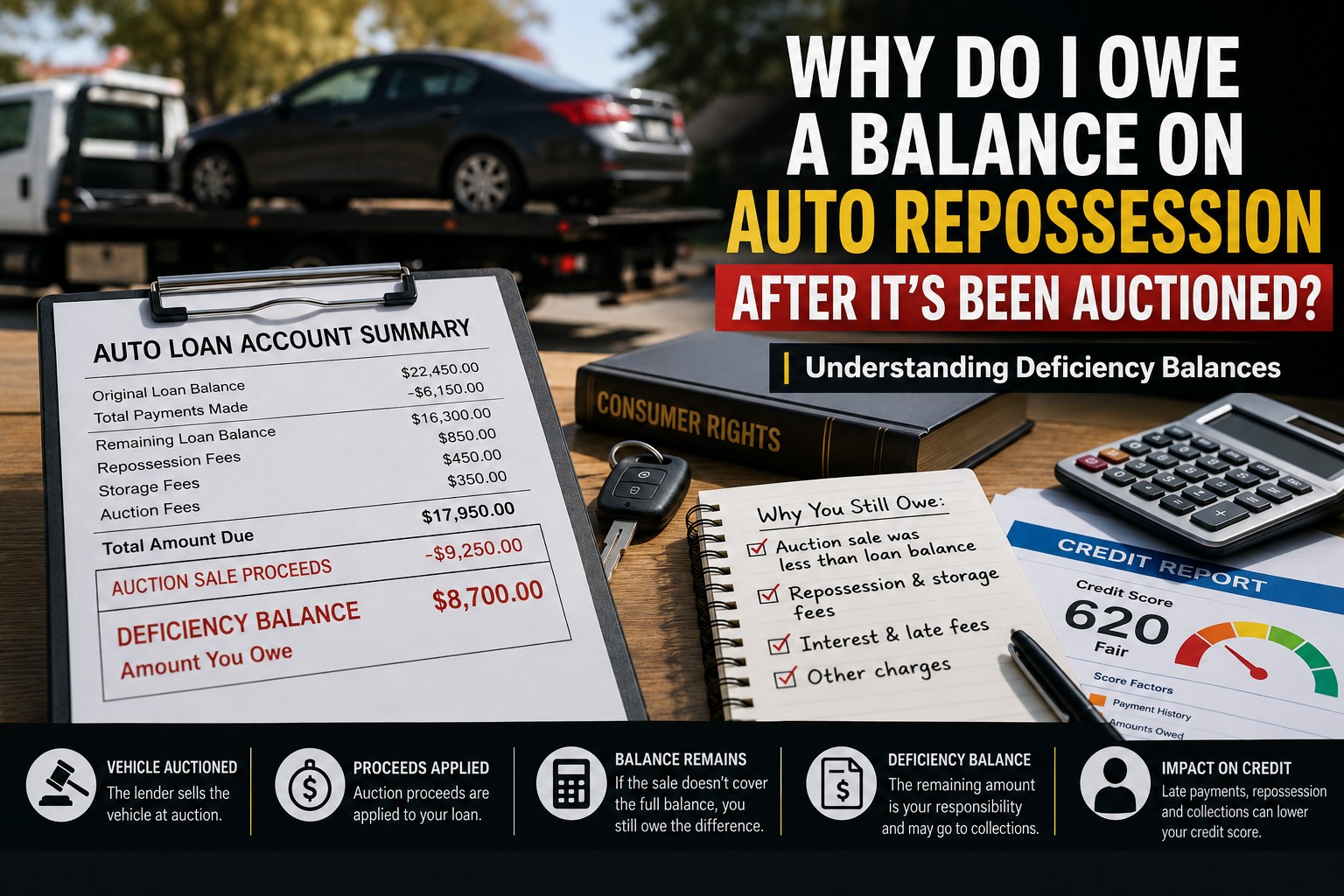

Why Do I Owe a Balance After My Car Was Repossessed and Auctioned?
Quick Answer: Why Do You Still Owe After Repossession?
Many consumers are shocked when they learn they still owe money after a repossessed vehicle gets auctioned. However, the lender usually applies the auction proceeds to the remaining loan balance first.
If the vehicle sells for less than what you owed, the remaining amount becomes a deficiency balance.
Therefore, even though the car is gone, the debt may still exist.
🔹 Quick Answer:
You may still owe money after an auto repossession auction because repossessed vehicles often sell for less than the remaining loan balance. The remaining amount is called a deficiency balance and may still be collectible.

In This Article You’ll Learn
✔ Why lenders still collect after repossession
✔ What a deficiency balance means
✔ How repossession auctions work
✔ Whether the balance can go to collections
✔ How to start repairing your credit afterward
Table of Contents
- Why You Still Owe After Auto Repossession
- What Happens During a Repossession Auction
- What Is a Deficiency Balance?
- Why Auction Prices Are Usually Low
- Can the Remaining Balance Go to Collections?
- Can You Be Sued After Repossession?
- How Repossession Affects Your Credit Report
- How to Start Rebuilding Credit After Repossession
- Why Clients Choose Masters Credit Consultants
- People Also Ask
Why You Still Owe After Auto Repossession
Most consumers assume the repossessed vehicle completely pays off the loan once the lender takes it back.
However, that is usually not how repossession works.
Instead, the lender typically:
- Repossesses the vehicle
- Sends the vehicle to auction
- Sells the vehicle
- Applies the proceeds to your loan balance
- Bills you for the remaining amount
That remaining amount becomes your auto repossession balance.
Example of an Auto Repossession Balance
| Loan Details | Amount |
|---|---|
| Remaining Auto Loan Balance | $22,000 |
| Auction Sale Price | $13,500 |
| Repo Fees & Storage Costs | $2,000 |
| Remaining Deficiency Balance | $10,500 |
Therefore, even though the vehicle sold, the borrower may still owe thousands of dollars.
⚠️ Important:
Repossession auctions rarely sell vehicles for full market value. As a result, many borrowers still owe money afterward.
What Happens During a Repossession Auction?
After repossession, the lender usually sends the vehicle to a dealer auction or wholesale auto auction.
These auctions are designed for quick liquidation, not maximum value.
Therefore:
- Vehicles often sell below retail value
- Cosmetic damage lowers prices
- Mechanical issues reduce bids
- High mileage impacts value
- Rapid sales create lower returns
Additionally, lenders may add extra costs, including:
- Towing fees
- Storage fees
- Legal expenses
- Auction fees
- Administrative costs
Those expenses may increase the remaining balance owed.
What Is a Deficiency Balance?
A deficiency balance is the amount still owed after the lender sells the repossessed vehicle.
This balance may include:
- Remaining principal
- Interest
- Late fees
- Repossession fees
- Storage charges
- Auction costs
- Legal expenses
Therefore, repossession does not automatically eliminate the debt.
Why Deficiency Balances Surprise Consumers
Many borrowers never receive a clear explanation before repossession occurs.
As a result, they believe:
✔ “The lender took the car, so the debt is over.”
✔ “The auction should fully pay the loan.”
✔ “The lender cannot collect afterward.”
Unfortunately, that is often incorrect.
Why Auction Prices Are Usually So Low
Repossession auctions are not consumer retail sales.
Instead, lenders prioritize speed over top-dollar pricing.
As a result:
| Factor | Effect on Auction Value |
|---|---|
| Wholesale auction environment | Lower bids |
| Vehicle condition | Reduced value |
| High mileage | Lower resale price |
| Cosmetic damage | Smaller offers |
| Mechanical concerns | Dealer discounts |
| Quick liquidation | Reduced market competition |
Therefore, many repossessed vehicles sell for far less than consumers expect.
📌 Consumer Awareness:
Some consumers owe large balances even after luxury vehicles are auctioned because depreciation and fees reduce the final credited amount significantly.
Can the Remaining Balance Go to Collections?
Yes.
If the deficiency balance remains unpaid, the lender may:
- Send the balance to collections
- Sell the debt to a collection agency
- File a lawsuit
- Garnish wages in some states
- Continue reporting negative information
As a result, the repossession may create multiple negative accounts on your credit report.
These may include:
- Late payments
- Repossession status
- Charge-off notation
- Collection account
- Deficiency balance reporting
Can You Be Sued After Auto Repossession?
In many cases, yes.
Lenders or collection agencies may pursue legal action for unpaid deficiency balances.
However, state laws vary.
Some states provide additional consumer protections regarding:
- Auction notices
- Deficiency calculations
- Sale procedures
- Consumer disclosures
Therefore, reviewing the repossession documentation carefully is important.
How Auto Repossession Affects Your Credit Report
Auto repossession can significantly lower your credit score.
Additionally, the damage often extends beyond the repossession itself.
A repossession account may include:
- 30-day late payments
- 60-day late payments
- 90-day late payments
- Charge-off reporting
- Collection activity
- Deficiency balance
Therefore, one repossession may damage several areas of your credit profile simultaneously.
Most repossessions remain on credit reports for up to 7 years from the original delinquency date.
How to Start Rebuilding Credit After Repossession
The first step is reviewing your full credit profile carefully.
Then focus on rebuilding positive history strategically.
Step 1 — Review All Three Credit Reports
Check:
- Experian
- Equifax
- TransUnion
Look for:
- Incorrect balances
- Duplicate collections
- Inaccurate dates
- Reporting inconsistencies
- Re-aged accounts
If inaccurate reporting exists, disputes may help challenge the information.
For updated 3-bureau credit monitoring, Masters Credit Consultants recommends IdentityIQ with the $1 trial (7-day trial):
https://www.identityiq.com/securepreferred.aspx?offercode=431295SH
IdentityIQ includes:
✔ Experian, Equifax & TransUnion reports
✔ Daily monitoring alerts
✔ Credit scores
✔ Dark web monitoring
✔ $1,000,000 identity theft insurance
Step 2 — Build Positive Credit History
Focus on:
- On-time payments
- Low credit utilization
- Secured credit cards
- Credit-builder accounts
- Stable revolving accounts
Positive reporting becomes critical after repossession.
Step 3 — Work With a Professional Credit Repair Company
If you’re struggling with repossessions, collections, or charge-offs, a professional credit repair company may help review your credit reports for inaccurate, outdated, or unverifiable reporting.
Masters Credit Consultants helps clients review:
- Repossessions
- Charge-offs
- Collections
- Late payments
- Credit utilization issues
Why Clients Choose Masters Credit Consultants
With a 5.0-star rating across 80+ verified reviews, our clients consistently trust us to deliver real results and guidance they can rely on.
Many clients see results in 60–90 days. Additionally, some clients may begin seeing improvements in as little as 30 days depending on reporting accuracy and credit history.
Schedule Your Free Credit Consultation with Masters Credit Consultants
If repossessions, charge-offs, collections, or late payments are hurting your credit, Masters Credit Consultants may be able to help.
📞 Phone: 1-844-620-8796
🌐 Website: https://www.masterscredit.com
📅 Free Consultation:
https://masterscreditconsultantsfreeconsultationbooknow.as.me/schedule/912546ad/appointment/31582691/calendar/6643355
Additional Helpful Links
- Homepage: https://www.masterscredit.com
- Blog Hub: https://www.masterscredit.com/blogs/
- Consultation Page:
https://masterscreditconsultantsfreeconsultationbooknow.as.me/schedule/912546ad/appointment/31582691/calendar/6643355
People Also Ask
Why do I still owe after my car was repossessed?
You may still owe a deficiency balance if the auction sale did not fully pay the remaining loan amount and fees.
What is a deficiency balance after repossession?
A deficiency balance is the remaining debt owed after the repossessed vehicle is sold at auction.
Can repossession balances go to collections?
Yes. Lenders frequently send unpaid deficiency balances to collection agencies.
Can I settle a repossession balance?
In some cases, lenders or collection agencies may agree to settlements. However, terms vary by creditor.
Related Questions
- How to remove repossession from credit report
- What happens after voluntary repossession
- How long repossession stays on credit
- Can you finance another car after repossession
- How to rebuild credit after repo










Leave A Comment