
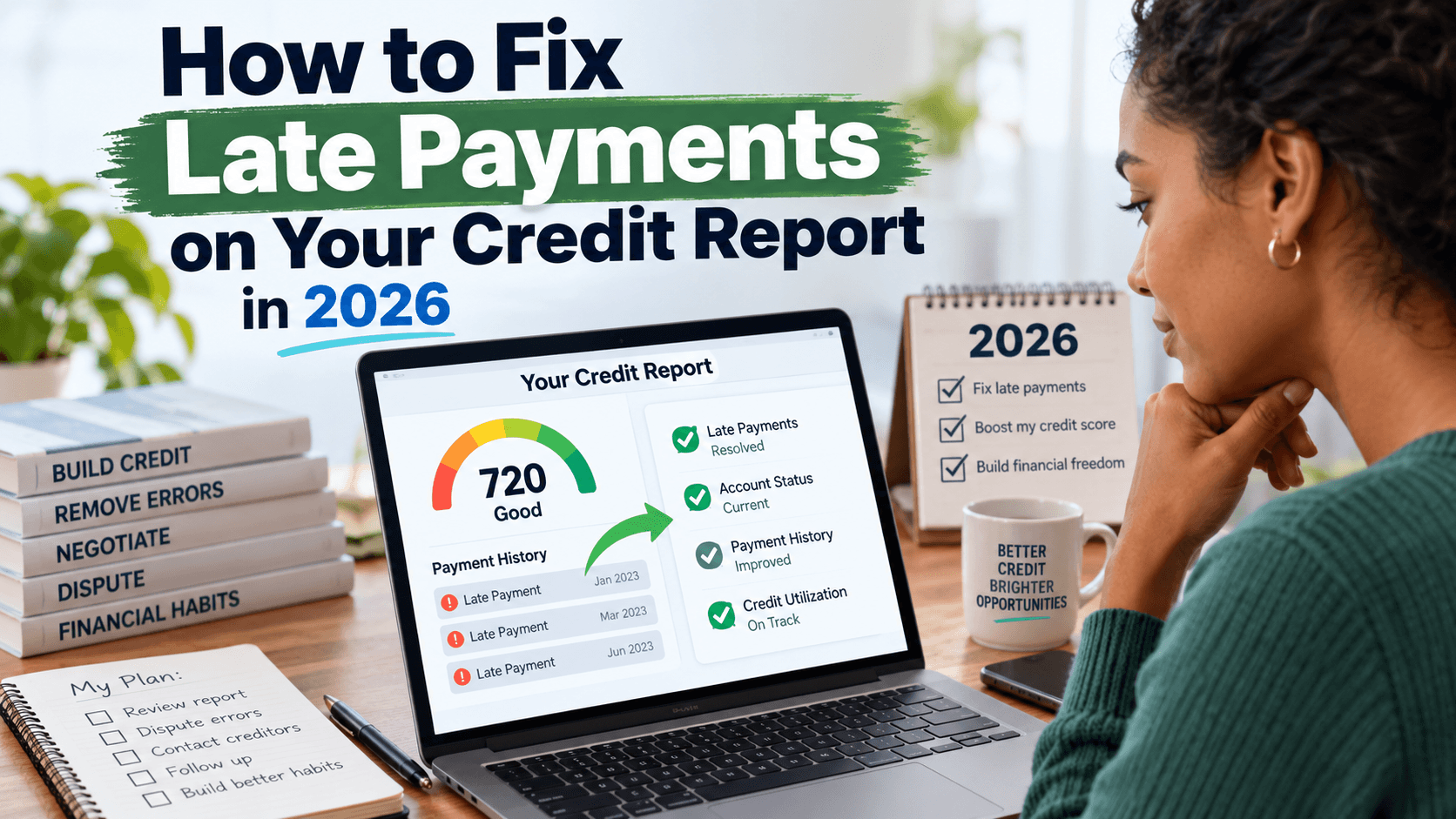

How to Fix Late Payments on Your Credit Report in 2026
A single late payment on your credit report can affect your credit score, increase borrowing costs, and make it harder to qualify for a mortgage, auto loan, or credit card.
If you’ve missed a payment, you may be wondering: Can you remove late payments from your credit report, and how do you fix them?
The answer depends on whether the late payment was reported accurately.
Under the Fair Credit Reporting Act (FCRA), consumers have the right to dispute inaccurate or incomplete information appearing on their credit reports. However, accurate late payments generally cannot be removed simply because they negatively affect your credit score.
The good news is that even if a late payment cannot be removed, there are practical steps you can take to improve your credit profile over time.
At Masters Credit Consultants, we help consumers understand their credit reports, identify potential reporting errors, and explore responsible strategies for improving their credit.
In this guide, we’ll explain how late payments affect your credit score, when they can be removed, how to dispute inaccurate information, and what you can do to rebuild your credit in 2026.

Can You Remove Late Payments From Your Credit Report?
Yes, late payments can be removed from your credit report under certain circumstances.
If a payment was incorrectly reported as late, you have the right to dispute the information with the credit reporting agencies and the company that furnished the information.
For example, a late payment may be inaccurate if:
- You made the payment on time, but it was recorded incorrectly.
- Your payment was applied to the wrong account.
- The creditor reported the wrong delinquency date.
- The account does not belong to you.
- A previously corrected reporting error reappeared.
- The late payment is older than the legally permitted reporting period.
However, if you genuinely missed a payment and the creditor reported it correctly, the late payment may remain on your credit report for up to seven years.
Important: No legitimate credit repair company can guarantee the removal of accurate late payments.
The first step is reviewing your credit reports to determine exactly what is being reported.
Masters Credit Consultants recommends obtaining a copy of your 3-bureau credit report through IdentityIQ’s $1 7-Day Trial, which provides access to your credit reports, scores, monitoring alerts, and identity theft protection.
Eligible IdentityIQ plans allow Experian, Equifax, and TransUnion reports and scores to be refreshed every 30 days.
Start Your IdentityIQ $1 7-Day Trial
Review the current trial, subscription pricing, and cancellation terms before enrolling.
How Do Late Payments Affect Your Credit Score?
Payment history is one of the most important factors used to calculate your credit score.
For FICO Scores, payment history accounts for approximately 35% of the overall calculation, although the impact of a specific late payment depends on your entire credit profile.
Late payments are generally categorized according to how long an account remains overdue.
30 Days Late
A payment that becomes at least 30 days overdue may be reported to the credit bureaus.
A single 30-day late payment can negatively affect your credit score, especially if you previously had a strong payment history.
60 Days Late
When a payment becomes 60 days overdue, the account reflects a more serious delinquency.
A 60-day late payment may have a greater negative impact than a 30-day delinquency.
90 Days Late
A 90-day late payment indicates that the account has been delinquent for approximately three months.
This level of delinquency may significantly affect your credit profile and increase the risk of additional collection activity.
120 Days or More Late
Accounts that remain unpaid for extended periods may eventually be charged off or transferred to collections, depending on the type of account and creditor policies.
A charge-off does not mean the debt has been forgiven. The consumer may still owe the outstanding balance.
The longer an account remains delinquent, the more serious the potential consequences may become.
How to Fix Late Payments on Your Credit Report: 7 Steps
If you discover a late payment on your credit report, follow these steps to determine whether it can be corrected and how to prevent additional damage.
Step 1: Review All Three Credit Reports
Start by obtaining your credit reports from Experian, Equifax, and TransUnion.
A late payment may appear on one credit report but not another, or the reported dates may differ.
Review the following information carefully:
- Creditor or lender name.
- Account number or identifying details.
- Payment history.
- Reported delinquency dates.
- Account balance.
- Current account status.
- Any collection or charge-off information.
Masters Credit Consultants recommends using IdentityIQ’s $1 7-Day Trial to access three-bureau credit information, scores, monitoring alerts, and identity protection services.
Experian, Equifax, and TransUnion reports and scores can be refreshed every 30 days under eligible plans.
You can also obtain free credit reports through AnnualCreditReport.com, the federally authorized website.
Step 2: Determine Whether the Late Payment Is Accurate
Before filing a dispute, verify whether the payment was genuinely late.
Check bank statements, payment confirmations, account histories, and communications from your lender.
For example, if your credit card payment was due on March 10 and the creditor received it on March 12, the payment may have been late under your account agreement.
However, a payment that was only two days late would not ordinarily qualify as a 30-day delinquency for credit bureau reporting.
You may still be charged a late fee depending on the account terms, even if the payment is not reported as 30 days late.
Understanding this distinction can help you identify potential reporting errors.
Step 3: Gather Supporting Documentation
If you believe the late payment was reported incorrectly, collect evidence supporting your position.
Useful documentation may include bank statements, payment receipts, transaction records, account statements, and written communications from the creditor.
The more clearly you can explain the reporting issue, the easier it may be for the credit bureau or creditor to investigate.
Step 4: Dispute the Inaccurate Late Payment
Under the FCRA, you can dispute inaccurate or incomplete credit reporting information.
You may submit disputes directly to Experian, Equifax, and TransUnion, as well as to the creditor responsible for reporting the information.
Your dispute should identify the account, explain the specific error, and include copies of relevant supporting documents.
Credit reporting agencies generally have 30 days to investigate disputes, although certain circumstances allow additional time.
If the investigation determines that the information is inaccurate, incomplete, or cannot be verified, it must be corrected or deleted as appropriate.
A dispute does not guarantee removal.
Step 5: Contact the Original Creditor
If the late payment is accurate, you may consider contacting the creditor directly.
Some creditors may be willing to review requests for goodwill adjustments, particularly when the customer has an otherwise positive payment history.
A goodwill request typically explains the circumstances surrounding the missed payment and asks the creditor to consider adjusting the reported information.
However, creditors are not required to grant these requests, and they have obligations to report accurate information.
A goodwill letter should never misrepresent the facts or claim that an accurate late payment was reported incorrectly.
Step 6: Bring Overdue Accounts Current
If your account is still past due, bringing it current may help prevent additional late-payment reporting.
For example, an account that is currently 30 days overdue could eventually become 60 or 90 days delinquent if no action is taken.
Contact your lender to discuss payment arrangements or hardship assistance if you’re having difficulty catching up.
Some lenders offer temporary payment assistance or other options for eligible borrowers.
Step 7: Build Positive Payment History
Even if a late payment remains on your credit report, consistent positive payment activity may help strengthen your credit profile over time.
Focus on paying bills on time, keeping credit card balances manageable, avoiding unnecessary debt, and regularly monitoring your credit information.
Improving credit is a long-term process, but small, consistent actions can make a meaningful difference.
Can a Goodwill Letter Remove Late Payments?
A goodwill letter is a written request asking a creditor to consider removing or adjusting an accurately reported late payment as a courtesy.
Consumers sometimes use goodwill letters when a missed payment resulted from unusual circumstances, such as a temporary financial hardship or administrative misunderstanding.
However, goodwill adjustments are discretionary.
A creditor is not legally required to remove an accurate late payment simply because a consumer requests it.
What Should a Goodwill Letter Include?
A goodwill letter generally explains your relationship with the creditor, the circumstances surrounding the late payment, and the steps you’ve taken to prevent future missed payments.
Keep the letter professional, truthful, and concise.
Avoid making unsupported claims or demanding removal of accurate information.
A goodwill request is different from an FCRA dispute. A dispute challenges information believed to be inaccurate or incomplete, while a goodwill request asks for discretionary consideration.
How Long Do Late Payments Stay on Your Credit Report?
Accurately reported late payments can generally remain on your credit report for up to seven years.
The reporting period is tied to the relevant delinquency information, and paying the account later does not ordinarily restart that period.
For example, a late payment reported in 2021 may remain visible until approximately 2028.
However, its effect on your credit score may decrease as it ages, especially when you establish a consistent history of on-time payments.
The impact depends on the scoring model and other information in your credit file.
A late payment that remains visible does not necessarily affect your score as strongly throughout the entire reporting period.
Will Your Credit Score Go Up After a Late Payment Is Removed?
Removing an inaccurate late payment may improve your credit score, but the amount of improvement varies.
Factors that influence the outcome include:
- How recently the late payment occurred.
- Whether it was 30, 60, or 90 days late.
- How many other late payments appear on your report.
- Your credit utilization.
- The length of your credit history.
- The credit scoring model used.
There is no guaranteed point increase after a late payment is removed.
For some consumers, the change may be significant. For others, the improvement may be limited because other negative factors remain.
The most reliable approach is to address legitimate reporting errors while continuing to develop positive credit habits.
Can Credit Repair Companies Help Remove Late Payments?
Professional credit repair services may help consumers identify inaccurate reporting, organize documentation, and understand their options under federal credit reporting laws.
At Masters Credit Consultants, we focus on helping consumers better understand the information appearing on their credit reports and the steps available to address potential errors.
Credit Report Review
Reviewing information across the three major credit bureaus can help identify discrepancies involving payment history, account status, or delinquency dates.
Identifying Potential Errors
Not every negative account qualifies for removal.
Professional assistance can help distinguish potentially inaccurate information from legitimate negative credit history.
Dispute Preparation and Guidance
When appropriate, consumers may benefit from help organizing account-specific disputes and supporting documentation.
You also have the right to dispute inaccurate credit information yourself at no cost.
Long-Term Credit Improvement Planning
Addressing past reporting issues is only one part of improving credit.
Developing responsible payment habits and monitoring account activity can help support healthier credit over time.
If you’ve previously disputed a late payment and received a verified response, explore our related article: My Credit Dispute Came Back Verified. Now What?
How Kikoff May Help You Build Positive Credit History
While addressing late payments, you may also want to explore financial tools that support consistent credit-building habits.
Kikoff offers credit-building products designed to help eligible consumers establish payment history and manage certain aspects of their credit profiles.
Depending on the product, available features may include credit-building accounts, payment reporting options, and financial monitoring tools.
Kikoff does not erase accurately reported late payments or guarantee an increase in your credit score.
However, responsible use of an appropriate credit-building product may help establish positive payment information over time.
Explore Kikoff Credit-Building Options
Review current product eligibility, fees, reporting practices, and terms before enrolling.
Common Mistakes to Avoid When Fixing Late Payments
Trying to correct late payments without understanding the reporting process can create frustration and unnecessary delays.
Disputing Accurate Information Without a Valid Reason
A late payment that negatively affects your score is not automatically inaccurate.
Focus disputes on genuine reporting errors.
Using Generic Dispute Letters
A generic letter may fail to explain the actual problem.
Specific, evidence-supported disputes are generally more useful than vague requests to remove negative information.
Ignoring Other Credit Report Errors
Late payments are not the only reporting problems that may affect your credit.
Incorrect balances, outdated collection accounts, and inaccurate account statuses may also require attention.
Expecting Immediate Credit Score Improvements
Even when an error is corrected, credit scores may not update immediately.
Credit bureaus, creditors, and scoring services update information according to their respective reporting schedules.
Missing Additional Payments
One of the most important steps is preventing further delinquency.
Set up payment reminders or automatic payments when appropriate and ensure sufficient funds are available.
Frequently Asked Questions
Can I remove a 30-day late payment from my credit report?
Yes, if the 30-day late payment was reported inaccurately or otherwise requires correction or deletion under applicable law. An accurate 30-day late payment generally cannot be removed through a dispute simply because it is negative.
Can I remove a 60-day or 90-day late payment?
The same general rules apply. If the information is inaccurate, incomplete, or unverifiable, it may qualify for correction or deletion. Accurate delinquencies may remain for the legally permitted reporting period.
Does paying a late account remove the late payment?
No. Paying an overdue account generally updates its balance or status, but the historical late payment may remain on your credit report.
Can I dispute late payments online?
Yes. Experian, Equifax, and TransUnion provide online dispute options. You may also submit disputes through other available channels.
How long does it take to remove an inaccurate late payment?
Credit bureaus generally investigate disputes within 30 days, although some investigations may take longer under legally permitted circumstances.
Can a goodwill letter remove an accurate late payment?
A creditor may consider a goodwill request, but removal is not guaranteed. Creditors are generally expected to report accurate information.
Will one late payment ruin my credit?
One late payment can negatively affect your score, but it does not permanently prevent you from improving your credit. Its impact may decrease over time as you establish positive payment history.
Can late payments affect mortgage approval?
Yes. Mortgage lenders may review payment history when evaluating creditworthiness. Recent or repeated delinquencies may affect eligibility, underwriting decisions, or loan terms.
Can Kikoff remove late payments from my credit report?
No. Kikoff is not a tool for deleting accurately reported late payments. Its credit-building products may help eligible users establish positive payment history.
Is it worth hiring a credit repair company for late payments?
Professional assistance may be useful when you have multiple reporting issues or need help understanding complex credit information. However, you can dispute inaccurate credit reporting information yourself for free, and no company can guarantee the removal of accurate negative information.
Get a Free Credit Analysis With Masters Credit Consultants
Late payments can make it harder to achieve your financial goals, but they don’t have to define your financial future.
Whether you’re dealing with a single 30-day delinquency or multiple late payments across different accounts, understanding your credit report is the first step toward making informed decisions.
At Masters Credit Consultants, we help consumers identify potential credit reporting issues, understand their options, and develop responsible strategies for improving their financial profiles.
If you’re unsure whether the late payments on your credit report are accurate, professional guidance can help you determine what to review next.
Ready to Take the First Step Toward Better Credit?
SCHEDULE YOUR FREE CREDIT CONSULTATION
Or GET STARTED TODAY with Masters Credit Consultants.
Your credit improvement journey starts with understanding what’s on your report and taking action where it matters.
🚀 Schedule Your Free Credit Consultation with Masters Credit Consultants
Schedule a free consultation with Masters Credit Consultants and discover how a personalized credit improvement strategy can help you achieve your financial goals.
Whether you’re preparing to buy a home, qualify for better financing, rebuild after financial hardship, or strengthen your business opportunities, taking action today could open the door to greater possibilities tomorrow.
📞 Phone: 1-844-620-8796
🌐 Website: https://www.masterscredit.com
📅 Schedule Your Free Consultation:
https://www.masterscredit.com/sign-up/
Additional Helpful Links
- Check Your Credit Before Buying a Home: What to Look for First
- What Does a Credit Repair Specialist Do? What to Know Before You Sign Up
- Can Bad Credit Make It Harder to Rent an Apartment? What to Check Before You Apply
- Tired of Credit Denials? How Credit Repair Services Can Help You Review What Lenders See
Related Questions
- Can you remove late payments from your credit report in 2026?
- How long do late payments stay on your credit report, and when do they stop affecting your credit score?
- Can you dispute a late payment on your credit report if it was reported incorrectly?
- Does a goodwill letter work for removing accurate late payments from your credit report?
- How much can a 30-day, 60-day, or 90-day late payment affect your credit score?
- What is the fastest way to rebuild your credit score after a late payment?







Leave A Comment