
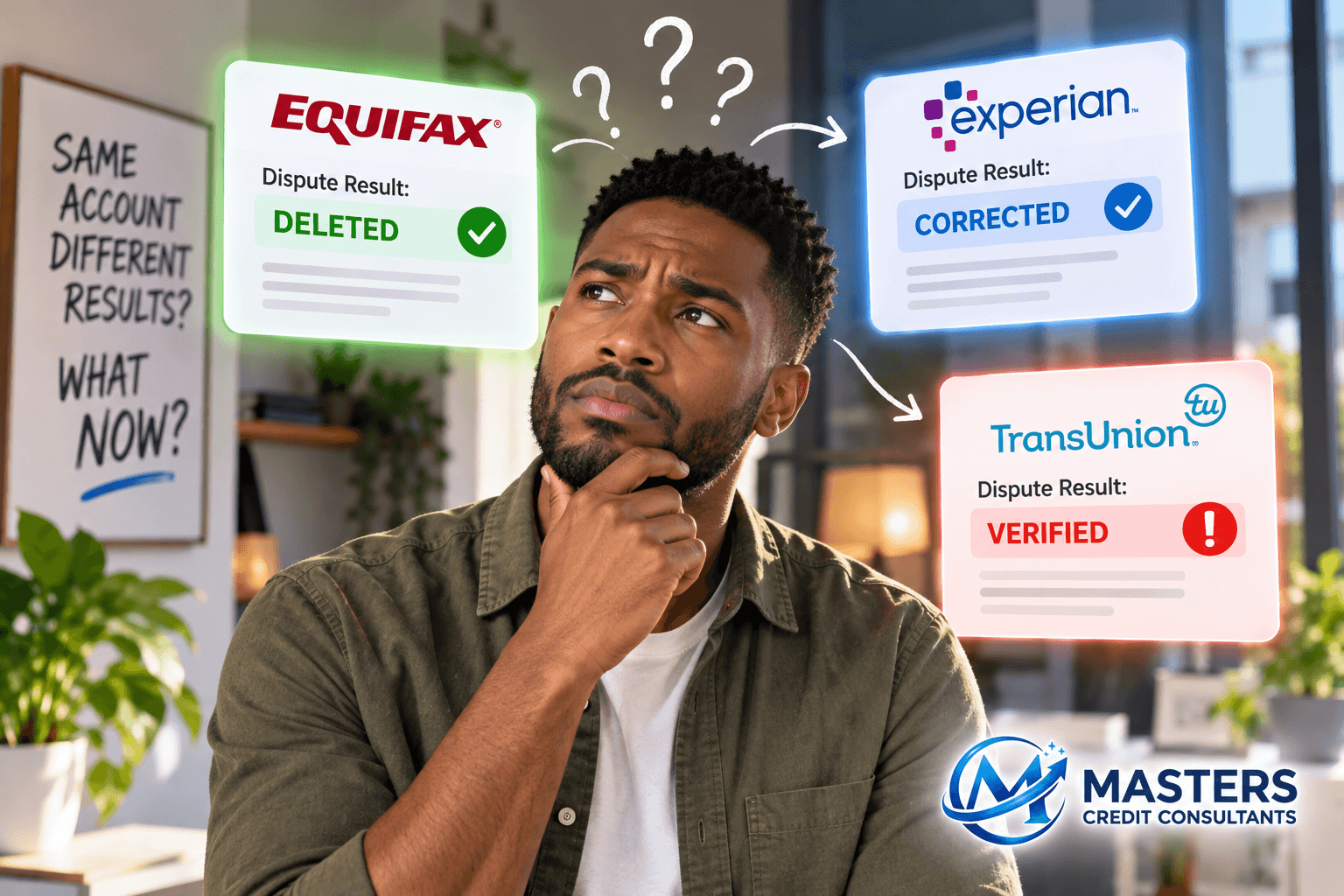

Credit Report Dispute Results Don’t Match Across Equifax, Experian, and TransUnion: What Next?
When a credit report dispute produces different results from Equifax, Experian, and TransUnion, it doesn’t automatically mean one bureau is wrong. Each bureau investigates separately, and the right next step is to compare the disputed information, identify what remains inaccurate, and challenge that specific error with supporting evidence.
If you’ve been researching credit repair services because one bureau corrected an account while another refused, understanding these differences can help you avoid unnecessary disputes and focus on what actually needs fixing.
In This Article You’ll Learn:
- Why credit bureaus disagree: Understand why the same disputed account can produce three different outcomes.
- How to challenge unresolved errors: Learn the steps, documentation, and consumer rights that can support your next dispute.
- How to move forward financially: Discover responsible credit-building options, including Kikoff, while addressing reporting inaccuracies.
Table of Contents
- Why Credit Report Dispute Results Don’t Match
- What Deleted, Updated, and Verified Really Mean
- The Three-Bureau Credit Report Comparison Strategy
- Five Reasons Equifax, Experian, and TransUnion Disagree
- What to Do When One Credit Bureau Won’t Correct an Error
- Your Rights Under the Fair Credit Reporting Act
- When to Dispute Directly With the Creditor
- Should You Dispute the Same Account Again?
- How Credit Dispute Errors Affect Business Funding
- Building Credit While Your Dispute Is Pending With Kikoff
- When Credit Repair Services May Be Worth Considering
- People Also Ask About Credit Report Disputes
- The Best Next Step Is Accuracy, Not Just Deletion
Why Credit Report Dispute Results Don’t Match
Imagine this situation.
You discover an incorrect late payment on your credit file. You have the bank statement to prove you paid on time, so you dispute the information with all three major credit bureaus.
A few weeks later, your results arrive.
Equifax deleted the account.
Experian corrected the late payment.
TransUnion verified the information and left the late payment unchanged.
Same account. Same consumer. Three different decisions.
It’s easy to assume that something went wrong during the investigation. But the explanation isn’t always that simple.
Equifax, Experian, and TransUnion are independent consumer reporting agencies. Each maintains its own credit file and receives information from lenders, creditors, and collection agencies.
Not every creditor reports identical information to all three bureaus. Reporting dates, submitted records, and investigation responses can also differ.
For this reason, a successful dispute with one bureau does not automatically require another bureau to reach the same conclusion.
Conflicting credit dispute results may occur because the bureaus maintain different records, receive different documentation, or obtain different responses from the information furnisher. The important question is whether the information remaining after the investigation is accurate.
For consumers, especially those preparing for a major financial decision, knowing how to interpret these results can prevent wasted effort.
What Deleted, Updated, and Verified Really Mean
Credit bureaus commonly use terms such as deleted, updated, or verified when communicating investigation results.
Understanding these terms is essential because they describe different outcomes.
| Dispute Result | What It Generally Means | What to Consider Next |
|---|---|---|
| Deleted | The disputed information was removed from the bureau’s file. | Determine whether the correction addresses the disputed error. |
| Updated | One or more reported details were changed. | Confirm the information now reflects the correct facts. |
| Verified | The investigation left the disputed information unchanged. | Determine whether the specific inaccuracy was reasonably investigated. |
| Remains disputed | The consumer continues to disagree with the information. | Consider further documentation or applicable consumer rights. |
Consider a hypothetical consumer named Daniel.
Daniel disputes a 30-day late payment on a credit card account. He has evidence showing that the payment was submitted on time.
Equifax deletes the entire account. Experian removes the disputed late-payment notation. TransUnion leaves the late payment unchanged.
Which result is best?
Not necessarily Equifax’s deletion.
If the account contains years of accurate, positive payment history, removing the entire account could affect the information used in certain credit scoring models.
Experian’s correction may preserve accurate positive history while resolving the specific error.
TransUnion’s unchanged reporting deserves further examination if Daniel’s documentation supports his position.
The goal of a credit report dispute should be accurate and complete information, not simply the greatest number of deleted accounts.
The Three-Bureau Credit Report Comparison Strategy
Before submitting another dispute, you need a clear picture of what each bureau is currently reporting.
Rather than comparing only investigation result letters, compare the actual account information.
This is where a structured three-bureau comparison becomes useful.
Masters Credit Consultants recommends obtaining a copy of your 3-bureau credit report through IdentityIQ’s $1 7-Day Trial, which provides access to credit reports, scores, monitoring alerts, and identity theft protection.
IdentityIQ $1 (7-Day Trial)
Start Your IdentityIQ $1 7-Day Trial
The advertised offer includes the following features:
- Experian, Equifax and TransUnion™ Reports & Scores Can Be Refreshed Every 30 Days
- 3 Bureau Daily Monitoring & Alerts
- Dark Web Monitoring
- $1,000,000 Identity Theft Insurance
The exact features depend on the promotional plan and its terms. Identity theft insurance is subject to policy conditions, exclusions, and coverage limits.
Once you’ve gathered the information, create a side-by-side comparison.
Example: What a three-bureau comparison can reveal
| Account Detail | Equifax | Experian | TransUnion |
|---|---|---|---|
| Account status | Deleted | Open | Open |
| Outstanding balance | Not reported | $850 | $850 |
| Late payment | Not reported | Corrected | Still reported |
| Last reported update | Not reported | September 2026 | August 2026 |
| Investigation result | Deleted | Updated | Verified |
Notice what this comparison reveals.
The primary issue isn’t that three bureaus produced different decisions.
The unresolved issue is the late payment that remains on TransUnion.
This distinction changes the next step.
Instead of disputing the entire account again, Daniel can focus on the specific late-payment notation and provide supporting documentation.
That is a more precise approach than arguing that TransUnion must delete the account because Equifax did.
A practical comparison should focus on account ownership, balances, payment history, reporting dates, and the specific information being challenged.
Keep dated copies of the information and related correspondence so that you can track the dispute’s progress.
Five Reasons Equifax, Experian, and TransUnion Disagree
Different credit bureau decisions can have several explanations. Here are five worth investigating.
- The creditor furnished different information.
A lender might report an incorrect balance to one bureau while another bureau already has the corrected figure.
If the original records are different, the investigation outcomes may differ.
- The supporting documents were not identical.
Suppose you submitted a bank statement to Experian but only a short written explanation to TransUnion.
The available evidence may differ between investigations.
This does not remove a bureau’s obligation to conduct a reasonable reinvestigation. However, it makes reviewing your submissions important.
- The creditor corrected its records at different times.
Creditors may update information after discovering a reporting problem.
One bureau might receive an update before another bureau processes it.
A temporary discrepancy may therefore reflect timing rather than a permanent disagreement.
- One bureau could not verify the disputed information.
A reporting agency may delete disputed information when it cannot verify the information during a required reinvestigation.
Another bureau may receive information supporting the existing account details.
A deletion on one file is not conclusive proof that another file contains an error.
- The investigation may not have resolved the specific issue.
This is an important possibility when consumers have detailed supporting evidence.
For example, confirming that a credit card account belongs to you does not necessarily resolve a separate dispute about whether a particular payment was late.
The investigation must reasonably address the information being challenged.
The key lesson is to separate the dispute’s reported outcome from the underlying accuracy of the account.
What to Do When One Credit Bureau Won’t Correct an Error
If one bureau continues reporting information you believe is inaccurate, avoid immediately repeating the same dispute.
Instead, use a more targeted process.
Step 1: Identify the exact error.
Be specific about what is inaccurate.
Examples include:
- An incorrect 30-day or 60-day late payment
- A balance that remains after the account was paid
- An account that does not belong to you
- An incorrect account status
- A duplicate collection balance
- An inaccurate date associated with a delinquency
The more precise the issue, the easier it is to explain and document.
Step 2: Gather supporting evidence.
Match your documents to the actual disputed information.
For example:
| Reporting Problem | Potential Supporting Evidence |
|---|---|
| Incorrect late payment | Bank statement, payment confirmation, payment ledger |
| Wrong outstanding balance | Final statement, payoff letter, payment receipt |
| Account does not belong to you | Identity records, correspondence, evidence supporting mistaken identity |
| Incorrect account status | Account closure confirmation, lender correspondence |
| Duplicate collection | Collection notices, account statements, documentation of transfer or payment |
Supporting evidence should establish facts rather than merely repeat your disagreement.
Step 3: Review the original investigation results.
Determine whether the bureau corrected, deleted, or retained the specific information you challenged.
If the response did not adequately address your concern, consider requesting information about the reinvestigation procedure.
Step 4: Determine whether the creditor is the source of the problem.
Sometimes the bureau continues displaying an error because the furnisher’s records are inaccurate.
In those circumstances, a qualifying dispute directly with the creditor may be appropriate.
Step 5: Submit a focused follow-up dispute when warranted.
Use the specific error, relevant evidence, and prior correspondence to explain the unresolved issue.
A stronger explanation might say:
“I disputed a 30-day late payment reported for August 2026. My payment confirmation shows that the creditor received the payment before the due date. The previous investigation left the late payment unchanged. Please reinvestigate the specific payment history entry and correct any inaccurate reporting.”
This is more useful than simply writing that other bureaus removed the account.
Step 6: Keep a disputed history.
Record when disputes were submitted, which bureau received them, what evidence was included, and how each company responded.
A simple timeline helps prevent confusion when multiple investigations are underway.
Credit dispute checklist: Identify the error, match it with evidence, document previous results, choose the appropriate recipient, and retain copies of your correspondence.
Your Rights Under the Fair Credit Reporting Act
The Fair Credit Reporting Act, or FCRA, gives consumers important protections when they challenge inaccurate or incomplete information.
Understanding these protections can help you recognize when an investigation may require additional attention.
The right to a reasonable reinvestigation
Under 15 U.S.C. § 1681i, credit reporting agencies generally must conduct a reasonable reinvestigation of properly disputed information.
The standard investigation period is 30 days.
Certain circumstances allow up to 45 days.
The right to submit relevant evidence
Credit reporting agencies generally must review and consider relevant information submitted by consumers during the applicable investigation period.
This is why detailed documentation can matter.
The right to request the investigation procedure
If you disagree with the result, you may request a description of the procedure used to determine the accuracy and completeness of the disputed information.
The credit reporting agency generally must provide that description within 15 days after receiving your request.
The response may identify the furnisher contacted during the investigation.
However, the law does not automatically entitle consumers to every internal investigation document.
The right to dispute with the information furnisher
Consumers can submit qualifying direct disputes to the companies that furnished allegedly inaccurate information.
These companies generally have their own duties to investigate and correct inaccurate information under applicable federal requirements.
The right to add a consumer statement
If the dispute remains unresolved, you may request that the bureau include a brief statement describing your disagreement in your credit file.
This does not remove the disputed information or guarantee a favorable lending decision.
The right to pursue additional remedies
Depending on the circumstances, consumers may be able to submit a complaint to the Consumer Financial Protection Bureau, contact appropriate state authorities, or seek legal advice.
For complaints to the CFPB about inaccurate or incomplete information, the relevant bureau dispute generally must no longer be pending or at least 45 days must have elapsed.
For the governing requirements, see 15 U.S.C. § 1681i and the Consumer Financial Protection Bureau’s dispute guidance.
Important legal reminder: Federal law provides procedures for correcting inaccurate information. It does not guarantee deletion of accurate, legally reportable negative information.
When to Dispute Directly With the Creditor
Sometimes repeatedly contacting the credit bureau isn’t the most effective next step.
The problem may originate with the company supplying the account information.
Consider another hypothetical example.
A consumer pays off a vehicle loan in full. Equifax and Experian reflect the corrected zero balance, but TransUnion continues showing $4,500 outstanding.
The consumer disputes the balance with TransUnion.
The result comes back verified.
At this point, the consumer has reason to investigate whether the lender is continuing to furnish an incorrect balance.
A direct dispute might state:
“I paid this account in full on June 12, 2026. The outstanding balance should be zero. TransUnion continues reporting $4,500 despite my payment confirmation and final account statement. Please investigate the balance and correct any inaccurate information furnished to the credit reporting agencies.”
The consumer should send the dispute to the creditor’s designated dispute address and include copies of relevant documents.
A furnisher receiving a qualifying direct dispute generally must investigate and respond within the applicable period.
If the investigation establishes that the furnished information was inaccurate, the company generally must take appropriate corrective action and notify the affected reporting agencies.
The strategic difference: A bureau dispute addresses information appearing in a consumer reporting agency’s file. A direct furnisher dispute challenges the accuracy of information originating from the company that supplied it.
Both channels can be relevant, but neither automatically guarantees deletion.
Should You Dispute the Same Account Again?
Yes, a follow-up dispute can be appropriate when there is a legitimate reason to challenge the unresolved information.
However, repeatedly sending identical disputes without meaningful supporting information may not be productive.
A new dispute may be worthwhile when you:
- Discover new evidence contradicting the reported information
- Identify another specific inaccuracy
- Obtain creditor records supporting your position
- Find that the disputed issue was not reasonably addressed
- Receive new reporting information that introduces another discrepancy
For example, imagine that you previously disputed an inaccurate late payment but did not have the lender’s payment ledger.
Later, the lender provides a document showing the payment was received before the due date.
That document could provide an important additional basis for a focused follow-up dispute.
By contrast, repeatedly demanding deletion solely because another bureau removed the account may not establish that the remaining information is inaccurate.
The FCRA permits reporting agencies to decline disputes reasonably determined to be frivolous or irrelevant, subject to statutory notice requirements.
A better dispute is not necessarily a longer dispute. It’s one that clearly identifies the error and supports the requested correction.
For a related issue, see Masters Credit Consultants’ guide on how to fix late payments on your credit report.
How Credit Dispute Errors Affect Business Funding
Credit reporting accuracy matters beyond personal credit cards and mortgage applications.
For entrepreneurs and small business owners, personal credit information may also influence certain business financing decisions.
Many startup founders rely on personal guarantees, personal credit checks, or financing arrangements that consider the owner’s financial history.
An inaccurate late payment or outstanding collection could therefore create complications during some funding applications.
However, the actual impact depends on the lender, financing product, underwriting criteria, and the applicant’s overall financial circumstances.
Example: A startup founder preparing for funding
Imagine a business owner applying for financing to purchase equipment.
The lender reviews the applicant’s personal credit information because the financing requires a personal guarantee.
One credit bureau displays an unresolved late payment, while the other two show the corrected information.
The reporting difference may raise questions or influence the underwriting process.
Before applying, the entrepreneur should understand the discrepancy, gather supporting documentation, and address any confirmed inaccuracies through the appropriate channels.
But credit reporting accuracy is only one part of funding readiness.
Entrepreneurs should also consider:
- Whether their business is properly registered
- Whether personal and business finances are separated
- Whether business income and expenses are documented
- Whether financial projections are realistic
- Whether proposed financing fits expected cash flow
- Whether they understand any personal guarantee requirements
Correcting inaccurate credit information and preparing a business for financing are separate but complementary tasks. A stronger application also requires financial records, manageable obligations, and a credible repayment plan.
If you are preparing for a business opportunity and need guidance on the credit-related part of your financial readiness, consider scheduling a free consultation with Masters Credit Consultants.
A consultation can help you identify the credit concerns worth addressing before you make your next financing decision.
Building Credit While Your Dispute Is Pending With Kikoff
An unresolved credit dispute doesn’t necessarily mean every other financial goal must stop.
This is where consumers sometimes overlook an important distinction.
Credit correction and credit building are not the same thing.
Credit correction focuses on making existing information accurate.
Credit building focuses on establishing responsible financial activity over time.
Both may play a role in a long-term financial improvement strategy.
Consider someone who is challenging an inaccurate collection but also has very little active credit history.
Removing or correcting the inaccurate collection addresses an existing reporting problem.
Establishing a consistent payment record addresses a different concern.
That’s where Kikoff may be worth exploring.
How Kikoff’s credit-building approach differs
Kikoff offers credit-building plans designed to establish a reported credit account and payment history.
Its Credit Account is not a traditional spending line that can be used for ordinary purchases outside the platform.
Instead, eligible consumers enroll in a credit-building plan and make payments according to its terms.
Kikoff reports qualifying account and payment activity to credit bureaus.
Its published plan information describes options beginning at $5 per month, with features varying by subscription tier.
For consumers with limited credit history, the potential value is the opportunity to establish account activity through responsible payments.
But there is an important limitation.
Kikoff cannot correct an inaccurate late payment reported by another lender, remove a disputed collection, or guarantee a particular credit score increase.
Before enrolling in any credit-building program, consider whether the payments fit comfortably within your budget and whether the reported account will be useful for your financial goals.
For entrepreneurs, especially those preparing for future financing, it’s important to avoid taking on obligations simply to chase a credit score improvement.
Responsible payments, manageable balances, and accurate reporting remain important.
Explore the available credit-building options: Learn How Kikoff Works
When Credit Repair Services May Be Worth Considering
Not every credit dispute requires professional help.
Many consumers successfully challenge inaccurate information themselves at no charge.
However, professional assistance may be worth considering when reporting problems are complicated, involve multiple accounts, or remain unresolved after well-documented disputes.
Examples include:
- Conflicting investigation results involving several accounts
- Inaccurate collections appearing across multiple bureaus
- Disputed information involving identity theft or mixed credit files
- Inconsistent balances or payment histories
- Multiple reporting errors affecting financing preparation
The value of professional assistance should come from understanding the evidence, organizing the dispute process, explaining the consumer’s options, and helping develop a realistic strategy.
A legitimate credit repair company should never promise that every negative account can be removed.
Accurate and legally reportable information may remain even when the consumer would prefer its deletion.
Masters Credit Consultants provides credit analysis, dispute support, credit-building guidance, and personalized improvement strategies.
Its services may be useful for individuals who want a more structured approach to addressing potential inaccuracies.
Consumers can also explore the company’s credit repair and credit-building services to understand the available options.
For entrepreneurs, the wider objective should be more than simply obtaining a higher score.
It should include building financial habits, understanding credit obligations, preparing documentation, and avoiding unnecessary risks before pursuing growth opportunities.
People Also Ask About Credit Report Disputes
Why did Equifax delete my account but Experian and TransUnion didn’t?
Equifax, Experian, and TransUnion conduct separate investigations and may receive different records or verification responses from creditors. One bureau deleting an account does not automatically require the others to remove it. The next step is determining whether the remaining information is inaccurate and supporting your dispute with relevant evidence.
Can a credit bureau verify information that is actually incorrect?
Yes, an investigation may leave information unchanged even when a consumer believes it is inaccurate. A verified result does not make the information immune from further challenge. If you have evidence of a specific error, you may consider a properly supported follow-up dispute or contact the information furnisher directly.
Can credit report errors affect small business loan approval?
Potentially. Some business financing products involve personal credit checks or personal guarantees, particularly for newer businesses. Inaccurate payment histories, outstanding balances, or collection information may affect underwriting. Business owners should address documented errors and prepare accurate financial records before pursuing financing whenever practical.
The Best Next Step Is Accuracy, Not Just Deletion
When Equifax, Experian, and TransUnion return different credit dispute results, your first reaction might be to demand that every bureau produce the same outcome.
But identical results aren’t the real objective.
Accurate reporting is.
A deleted account isn’t automatically better than a corrected account. A verified result doesn’t automatically settle every question about the underlying information.
What matters is identifying the specific error, gathering reliable evidence, and using the appropriate dispute process.
That approach helps you make informed decisions rather than repeatedly challenging an account without a clear strategy.
For consumers working to rebuild their financial standing, the next step may involve correcting reporting inaccuracies, establishing consistent payment habits, or improving credit management.
For entrepreneurs, it may also mean preparing for business financing, separating personal and business finances, organizing financial documentation, and developing a sustainable growth strategy.
Masters Credit Consultants supports consumers and entrepreneurs through credit education, reporting analysis, dispute assistance, and personalized credit improvement planning.
Whether your objective is to repair inaccurate credit information, strengthen your credit profile, prepare for a new business, or pursue future financing, progress begins with understanding your financial position and taking appropriate steps.
Explore Masters Credit Consultants to learn more about credit improvement and financial readiness strategies.
There is no legitimate guarantee that a credit score can be repaired or improved quickly, but a focused, evidence-based approach can help you address errors and work toward stronger financial habits over time.
Better information leads to better decisions. And better decisions help build a stronger financial foundation.
Sources and Consumer Resources
- Consumer Financial Protection Bureau — How to Dispute an Error on Your Credit Report
- Consumer Financial Protection Bureau — How Long Does It Take to Repair an Error on a Credit Report?
- Fair Credit Reporting Act — 15 U.S.C. § 1681i
- Consumer Financial Protection Bureau — Credit Reporting Complaint Requirements
- Federal Trade Commission — IdentityTheft.gov
Disclaimer: This article provides general educational information about U.S. consumer credit reporting rights and does not constitute individualized legal or financial advice. The examples are hypothetical and do not represent actual Masters Credit Consultants client results. No credit repair company can guarantee the removal of accurate, legally reportable information or a particular credit score improvement. Consumers may dispute inaccurate credit information directly with credit reporting agencies at no charge. Some links are affiliate links, and Masters Credit Consultants may receive compensation when qualifying purchases or enrollments occur.
🚀 Schedule Your Free Credit Consultation with Masters Credit Consultants
Schedule a free consultation with Masters Credit Consultants and discover how a personalized credit improvement strategy can help you achieve your financial goals.
Whether you’re preparing to buy a home, qualify for better financing, rebuild after financial hardship, or strengthen your business opportunities, taking action today could open the door to greater possibilities tomorrow.
📞 Phone: 1-844-620-8796
🌐 Website: https://www.masterscredit.com
📅 Schedule Your Free Consultation:
https://www.masterscredit.com/sign-up/
Additional Helpful Links
- Can You Buy a House With Collections on Your Credit Report?
- How Long Does Credit Repair Take? What to Realistically Expect in 2026
- Can Credit Repair Really Remove Collections From Your Credit Report in 2026?
- Tired of Credit Denials? How Credit Repair Services Can Help You Review What Lenders See
Related Questions
- Why do Equifax, Experian, and TransUnion show different dispute results?
- What should I do if one credit bureau removes an error but the others don’t?
- Can I dispute the same inaccurate information again if my first dispute was unsuccessful?
- How long does it take for Equifax, Experian, and TransUnion to update my credit report after a dispute?
- What can I do if a credit bureau verifies information that I believe is inaccurate?
- Should I file a complaint with the CFPB if my credit report dispute remains unresolved?






Leave A Comment