
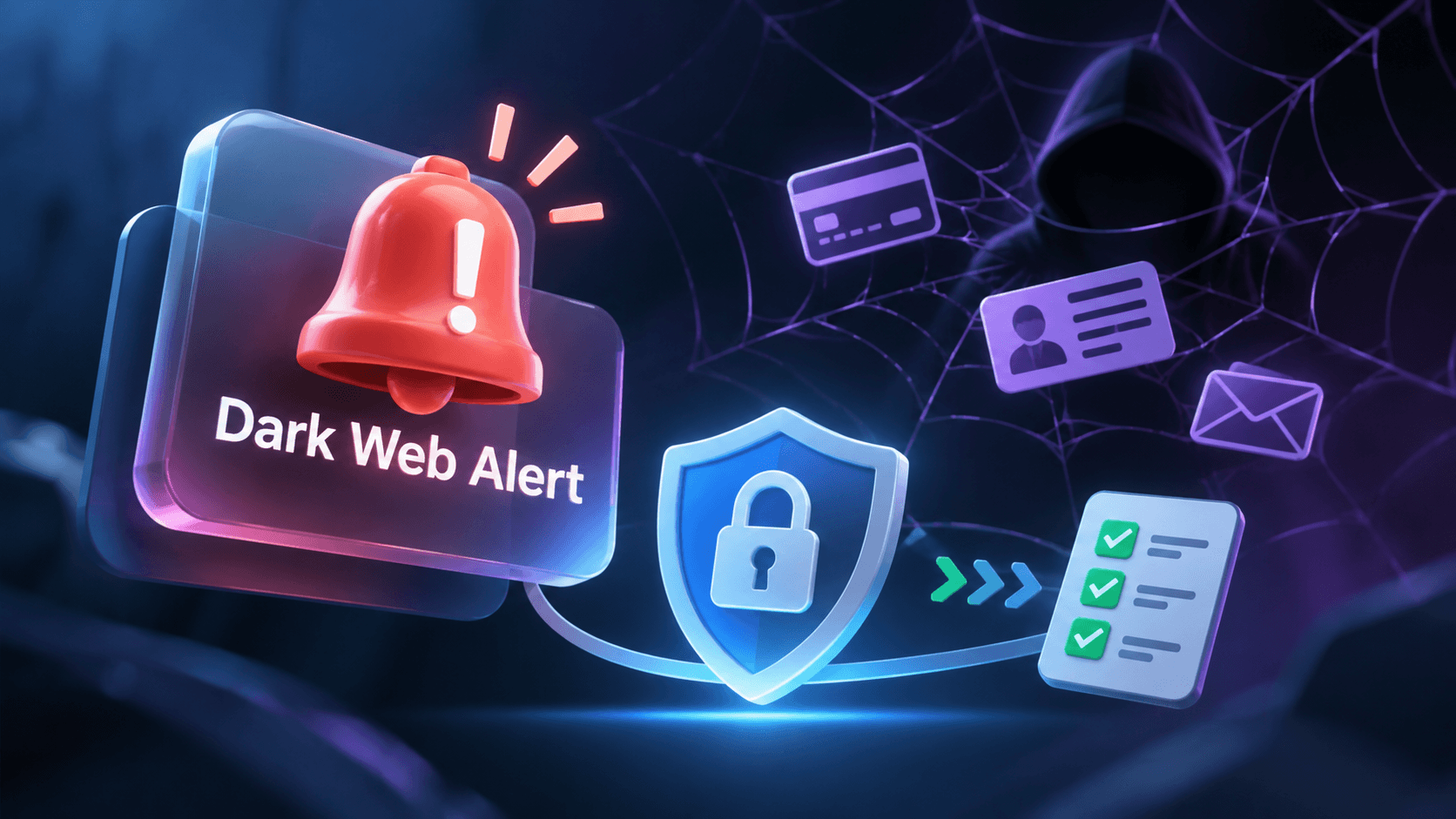

What Is a Dark Web Alert? What It Means, Why You Got One, and What to Do Next
A dark web alert means a security monitoring service has detected personal information associated with you in a leaked database, compromised account records, or another monitored source. It does not automatically mean your identity has been stolen or your accounts have been hacked. What matters most is which information was exposed, whether it is still usable, and what you do to protect yourself.
In This Article You’ll Learn
- How to tell whether your dark web alert is a minor exposure or a serious identity theft risk.
- What actions to take when your email, password, Social Security number, or financial information appears in an alert.
- How to monitor your identity, recognize credit-related fraud, and prevent exposed information from causing further damage.
Table of Contents
- What Does a Dark Web Alert Actually Mean?
- Why Am I Getting a Dark Web Alert Now?
- How Serious Is Your Dark Web Alert?
- What to Do in the First 15 Minutes
- What If Your Social Security Number Is on the Dark Web?
- Can a Dark Web Alert Lead to Credit Fraud?
- What Dark Web Monitoring Can and Cannot Do
- How to Protect Your Identity Without Overreacting
- Frequently Asked Questions
- The Smartest Response Is to Protect What Hasn’t Been Compromised
What Does a Dark Web Alert Actually Mean?
Imagine receiving a notification that says:
“Your personal information has been detected on the dark web.”
You haven’t noticed any suspicious transactions. Your email still works. Your banking app looks normal.
So why are you getting this warning?
The answer often has more to do with an earlier data breach than something happening to your accounts today.
The dark web refers to parts of the internet that require specialized software or configurations to access. Some of these spaces support legitimate privacy needs, while others are used to exchange stolen credentials, compromised databases, and illegal goods or services.
When a monitoring provider detects information associated with you in sources it tracks, it may generate an alert.
A dark web alert is evidence of detected exposure, not proof of identity theft.
For example, an online retailer may have experienced a security breach several years ago. Your email address could have been part of that incident.
If a monitoring company discovers the associated records today, you might receive a new notification about an old compromise.
That distinction changes how you should respond.
Instead of assuming someone is actively using your identity, first determine what information was found and whether it presents an ongoing risk.
Also, monitoring companies do not have access to every hidden website, private criminal forum, or leaked database. Their alerts reflect what their systems have detected—not everything that may exist online.
Why Am I Getting a Dark Web Alert Now?
One of the most confusing parts of dark web monitoring is the timing.
You might receive an alert in November 2026 about information connected to an account you stopped using years earlier.
This happens because the date your information was detected may be different from the date it was originally exposed.
There are several reasons for this.
An old data breach has resurfaced.
Stolen datasets are sometimes republished, combined with other records, or discovered long after the original incident.
A newly detected record does not necessarily mean a new breach occurred.
You recently activated a monitoring service.
When you begin using identity monitoring, the provider may compare your information against previously collected breach records.
That initial scan can generate alerts for historical exposure.
Your information was included in a larger credential collection.
Attackers sometimes combine leaked usernames, email addresses, and passwords from multiple incidents.
A monitoring service may discover your information within one of these collections without being able to identify a single original source.
A new breach has been detected.
In some cases, the alert genuinely relates to a recent security incident.
The provider may identify the affected organization or breach date, although that information is not always available.
A data broker or other source exposed personal details.
Certain monitoring products also look for personal information outside conventional breach databases.
The scope varies by provider.
Here’s what to check in the notification:
- The information exposed.
- The name of the affected company, if identified.
- The reported breach date.
- The detection date.
- Whether a password or financial credential was involved.
- Whether the information belongs to an account you still use.
These details are more useful than the notification’s alarming headline.
How Serious Is Your Dark Web Alert?
Not every exposure deserves the same response.
The seriousness of an alert depends on whether the detected information can help someone access an account, impersonate you, or commit financial fraud.
Consider three examples.
Situation A: Your email address was exposed five years ago.
The monitoring service finds an old email address in a historical breach.
You no longer use the affected website, and your email account is secured with a unique password and multifactor authentication.
This situation deserves awareness, but it does not automatically justify changing every account or freezing your credit.
You should remain cautious about phishing messages and verify that no related passwords remain in use.
Situation B: Your current password appears in a leaked database.
This is more concerning.
Someone who possesses your login credentials might attempt to access the affected account.
If you reused that password elsewhere, other accounts could also be vulnerable.
Change the compromised password immediately, update any accounts using the same credential, and check for unfamiliar sign-ins.
Situation C: Your Social Security number and other identifying details were exposed.
This deserves stronger precautions.
Although exposure does not prove misuse, a Social Security number combined with additional personal information can increase opportunities for identity-related fraud.
You may need to monitor your credit information, consider a security freeze, and investigate suspicious account activity.
The key distinction is whether someone has enough usable information to cause harm.
An exposed email address and an exposed Social Security number are not equivalent risks.
Remember: A notification should determine your next protective action—not automatically convince you that the worst has happened.
What to Do in the First 15 Minutes
You do not need to solve every possible security issue immediately.
But you should make the first few decisions carefully.
First: Do not click the alert’s links until you verify the source.
Criminals know that security warnings attract attention.
A fraudulent email claiming that your identity has been compromised may direct you to a convincing-looking website designed to steal your login credentials.
Open the provider’s app directly or type its official website address into your browser.
If the alert is legitimate, it should normally appear in your monitoring account.
Second: Find out what was actually exposed.
Look beyond phrases such as “personal information detected.”
Was it an email address? A password? A phone number? A Social Security number?
The correct response depends on the answer.
Third: Protect the accounts that could be accessed.
If a password was exposed, change it wherever it is still used.
Start with your email account if that password is affected.
Your email is particularly important because many websites use it for password resets and account recovery.
Review recent account activity, remove unknown sessions, and enable multifactor authentication.
Fourth: Contact financial institutions if financial credentials were compromised.
If payment card or bank account information was exposed, contact the institution using its verified contact channels.
Ask whether account restrictions, replacement credentials, or additional monitoring are appropriate.
If you already see unauthorized transactions, report them promptly.
Fifth: Save the details of the alert.
Record the provider, detection date, exposed data category, and any identified breach source.
Avoid storing complete passwords or Social Security numbers in unsecured documents.
These records may help you explain the situation later if suspicious activity occurs.
The objective of these first steps is simple: close the most immediate opportunities for unauthorized access before they become bigger problems.
What If Your Social Security Number Is on the Dark Web?
A dark web alert involving your Social Security number deserves special attention because that number is widely used in identity verification.
However, discovering that your number was exposed does not automatically mean someone has opened accounts in your name.
There are three separate concerns to evaluate.
- Has your identifying information been exposed?
The alert may establish that the monitoring provider detected your Social Security number or information associated with it.
That is a reason to improve identity protection.
It is not proof of a fraudulent transaction.
- Has someone attempted to use that information?
Unfamiliar credit applications, suspicious identity-verification messages, or unexpected financial account notices may indicate attempted misuse.
These signs require investigation.
- Has identity theft actually occurred?
If someone has opened an account or completed a transaction using your identity without permission, you may need to take formal identity theft recovery steps.
A practical precaution is to consider placing a credit freeze.
A credit freeze restricts access to your credit files for most new credit applications, making it harder for an identity thief to open accounts using your information.
Credit freezes are free and must be requested separately from Equifax, Experian, and TransUnion.
You can temporarily lift a freeze when a legitimate lender needs access to your report.
A fraud alert is another protective measure. An initial fraud alert instructs businesses to take additional identity verification steps before granting certain types of credit.
You generally need to contact only one nationwide credit bureau to establish an initial fraud alert with all three.
What a credit freeze cannot do: It does not prevent every form of identity theft, stop all unauthorized transactions, or erase fraudulent accounts that already exist.
If identity theft has occurred, you may also need to report the incident to the Federal Trade Commission and contact the affected businesses.
The important point is that exposure, suspected fraud, and confirmed identity theft call for different responses.
Can a Dark Web Alert Lead to Credit Fraud?
A dark web alert itself does not damage your credit score.
Credit scoring models do not lower your score simply because your personal information appeared in a leaked database.
The possible credit problems arise when exposed information is used fraudulently.
Consider this hypothetical situation.
A small business owner named Michael receives a dark web notification involving personal identifiers.
He secures his online accounts but assumes that because his bank transactions look normal, there is nothing else to investigate.
Later, Michael receives a letter welcoming him to a credit account he never applied for.
The unfamiliar account may indicate that someone used his identity to obtain credit.
For Michael, the issue has shifted from data exposure to suspected identity theft.
This is where accurate credit reporting becomes especially important.
Potential warning signs include:
- New accounts you did not authorize.
- Credit inquiries you cannot explain.
- Collection accounts connected to debts you do not recognize.
- Unexpected application denials.
- Correspondence from unfamiliar lenders.
- Inaccurate account information associated with suspected fraud.
Not every unfamiliar entry proves identity theft. A reporting mistake or incomplete information can sometimes explain an apparent discrepancy.
The proper response is to investigate the underlying facts before deciding which correction or recovery procedure applies.
When reviewing your credit reports becomes important
If sensitive identifying information was exposed or you suspect credit-related fraud, examining your reports from Equifax, Experian, and TransUnion can help reveal unfamiliar activity.
Consumers can obtain free credit reports through the federally authorized AnnualCreditReport.com system.
For readers who also want subscription-based monitoring, IdentityIQ offers a promotional option.
IdentityIQ: $1 Seven-Day Trial
The advertised trial includes:
- Experian, Equifax, and TransUnion reports and scores, refreshable every 30 days.
- Three-bureau daily monitoring and alerts.
- Dark web monitoring.
- Up to $1 million in identity theft insurance, subject to coverage terms and exclusions.
Explore IdentityIQ’s $1 Seven-Day Trial
Review the applicable trial conditions, renewal charges, cancellation requirements, and insurance policy details before enrolling.
IdentityIQ is a monitoring option, not a guarantee against identity theft or credit damage.
What if your credit reports show different information?
An unfamiliar account might appear on only one bureau’s report.
That’s possible because the three credit bureaus maintain separate records, and lenders do not always furnish identical information to each.
If you dispute a suspicious entry, the investigations may also produce different results.
For guidance on this specific reporting problem, see our article on why credit report dispute results don’t match across Equifax, Experian, and TransUnion.
That distinction matters because a correction with one bureau does not automatically establish that the other two have made the same change.
If you confirm that a fraudulent account resulted from identity theft, you may qualify for procedures that allow identity theft-related information to be blocked from your credit reports.
This is different from simply requesting deletion because an account is unfamiliar.
Proper documentation and an accurate explanation of the circumstances are important.
What Dark Web Monitoring Can and Cannot Do
Dark web monitoring can be useful, but understanding its limitations is essential.
Some consumers enroll in monitoring services believing those companies can find and delete all stolen information.
That is not how most monitoring services operate.
What monitoring can help you do
A monitoring service may notify you when certain personal information appears in sources it tracks.
Depending on the service, it may also identify historical breach records, detect exposed credentials, or provide recommendations for protecting affected accounts.
Some identity protection subscriptions combine these alerts with credit monitoring and insurance benefits.
These tools can improve awareness and help users respond to potential threats.
What monitoring cannot promise
No service can guarantee visibility into every stolen database or private criminal marketplace.
A provider may not discover an exposure immediately, and some compromised information may never trigger an alert.
Monitoring also cannot guarantee that stolen information will be removed from circulation.
Once sensitive data has been copied and distributed, complete deletion may be impossible to verify.
Perhaps most importantly, detecting exposed information does not automatically stop someone from trying to misuse it.
A monitoring alert becomes valuable when it leads to appropriate protective action.
The difference between monitoring and protection
Monitoring tells you when a potential issue has been detected.
Protective actions reduce opportunities for misuse.
For example:
- A password alert tells you that a credential may be exposed.
- Changing the password helps prevent continued use of that credential.
- Multifactor authentication provides an additional layer of account protection.
- A credit freeze helps restrict certain fraudulent credit applications.
- Reviewing financial activity helps identify transactions that require investigation.
No single tool performs all of these functions.
For consumers, choosing appropriate safeguards matters more than collecting multiple subscriptions that provide overlapping alerts.
How to Protect Your Identity Without Overreacting
A common mistake after receiving a dark web alert is treating every account as though it has already been compromised.
Another mistake is ignoring the notification entirely.
A more effective approach is to develop a manageable security routine.
Make your primary email account your security priority.
Your email is often connected to banking, credit cards, shopping accounts, business applications, and password recovery services.
Use a strong, unique password and multifactor authentication.
Check that your recovery email and phone number are accurate.
Reduce password reuse.
If one website suffers a breach, reusing the same password elsewhere creates opportunities for attackers.
A reputable password manager can help you maintain unique credentials without memorizing every password.
Separate your business access from your personal accounts.
For entrepreneurs, an exposed credential can affect more than personal information.
Business owners may use email accounts connected to customer records, payment processors, bookkeeping software, marketing platforms, and financial services.
Where practical, use separate business credentials, appropriate staff permissions, and strong authentication.
Review access when employees or contractors leave.
Be careful with unexpected verification requests.
After a breach, criminals may use exposed personal details to make phishing messages more convincing.
Someone who knows your name, address, or telephone number is not necessarily a legitimate representative of your bank.
Verify unusual requests using contact information obtained independently.
Review important account activity regularly.
You do not need to constantly monitor every notification.
Instead, establish a reasonable routine for checking financial transactions, account security messages, and relevant credit information.
If your financial profile is stable and you have not experienced identity misuse, monitoring may be a preventive measure rather than an emergency.
Keep identity protection separate from credit building.
Protecting your identity does not automatically improve your credit score.
Likewise, credit-building tools do not secure exposed passwords or remove information from breach databases.
If you are also working to establish a positive credit history, products such as Kikoff may be worth evaluating separately.
Kikoff offers credit-building products, but it is not a dark web monitoring or identity theft recovery service. Eligibility, costs, and credit reporting practices depend on the product.
For entrepreneurs preparing for financing
Identity security deserves a place in your financial planning.
An unauthorized account, unresolved identity theft issue, or inaccurate credit entry may complicate a future loan application.
Before pursuing financing, it’s sensible to understand your personal credit profile, organize business financial records, and investigate suspicious information.
If you have concerns about inaccurate reporting, Masters Credit Consultants provides credit education and assistance with understanding potentially disputable credit report information.
You can also schedule a free credit consultation to discuss your situation and available next steps.
A consultation is not a substitute for urgent account security measures, but it may help when suspected fraud has resulted in unresolved credit reporting problems.
Frequently Asked Questions
Why did I get a dark web alert if I haven’t been hacked?
You can receive a dark web alert even when none of your current accounts has been accessed. Monitoring services sometimes detect information from older company breaches, reused leaked databases, or records discovered years after the original exposure. The alert indicates detected information, not necessarily a recent account compromise.
Should I change my password after a dark web alert?
Change your password promptly if the alert identifies a credential that is still in use or you suspect unauthorized account access. Update any other accounts where you reused that password. If only an email address was exposed, changing unrelated unique passwords may not be necessary, but multifactor authentication remains important.
Can someone open a credit card using information from a dark web leak?
Potentially. If criminals obtain enough identifying information, they may attempt to submit fraudulent credit applications. However, a dark web alert alone does not prove that an application has occurred. A credit freeze can help restrict new-account fraud, while suspicious inquiries or unfamiliar accounts should be investigated promptly.
The Smartest Response Is to Protect What Hasn’t Been Compromised
A dark web alert can be unsettling because it raises questions you may not be able to answer immediately.
Who has your information? How long has it been exposed? Has anyone attempted to use it?
In many cases, the monitoring provider cannot answer all of those questions either.
But there is something you can control: your response.
Secure exposed credentials. Verify unusual account activity. Use stronger identity protection when sensitive identifiers are involved. Investigate financial information that does not belong to you.
And avoid assuming that every data breach will inevitably become identity theft.
The purpose of a dark web alert is to give you information you can act on—not to convince you that financial damage is unavoidable.
At Masters Credit Consultants, our work centers on helping consumers understand credit reporting issues, identify potentially inaccurate information, and pursue appropriate dispute strategies.
As a credit repair company, Masters Credit can assist clients who are dealing with reporting problems following suspected identity theft or other credit-related inaccuracies.
For entrepreneurs, understanding the accuracy of personal credit information can also be part of preparing for business financing and future growth opportunities.
However, neither a credit repair service nor an identity monitoring subscription can guarantee a particular credit score increase or eliminate every form of fraud.
The strongest financial strategy starts with knowing which problem you actually need to solve.
If you have received a dark web alert but your accounts remain secure, focus on prevention.
If you discover fraudulent financial activity, prioritize identity theft recovery.
And if inaccurate information appears on your credit report, investigate the reporting issue and the options available to correct it.
An alert tells you something may be wrong. Understanding the evidence tells you what to do next.
🚀 Schedule Your Free Credit Consultation with Masters Credit Consultants
Schedule a free consultation with Masters Credit Consultants and discover how a personalized credit improvement strategy can help you achieve your financial goals.
Whether you’re preparing to buy a home, qualify for better financing, rebuild after financial hardship, or strengthen your business opportunities, taking action today could open the door to greater possibilities tomorrow.
📞 Phone: 1-844-620-8796
🌐 Website: Masters Credit Consultants
📅 Schedule Your Free Consultation:
Additional Helpful Links
- Can You Buy a House With Collections on Your Credit Report?
- How Long Does Credit Repair Take? What to Realistically Expect in 2026
- Can Credit Repair Really Remove Collections From Your Credit Report in 2026?
- Tired of Credit Denials? How Credit Repair Services Can Help You Review What Lenders See
Related Questions
- What does it mean when you receive a dark web alert about your personal information?
- Why did I get a dark web alert if I haven’t noticed any suspicious activity on my accounts?
- What should I do immediately after receiving a dark web alert?
- Does a dark web alert mean my identity has been stolen or my accounts have been hacked?
- Can a dark web alert affect my credit score or put me at risk of identity theft?
- How can I protect my personal information and prevent future exposure after a dark web alert?





Leave A Comment