
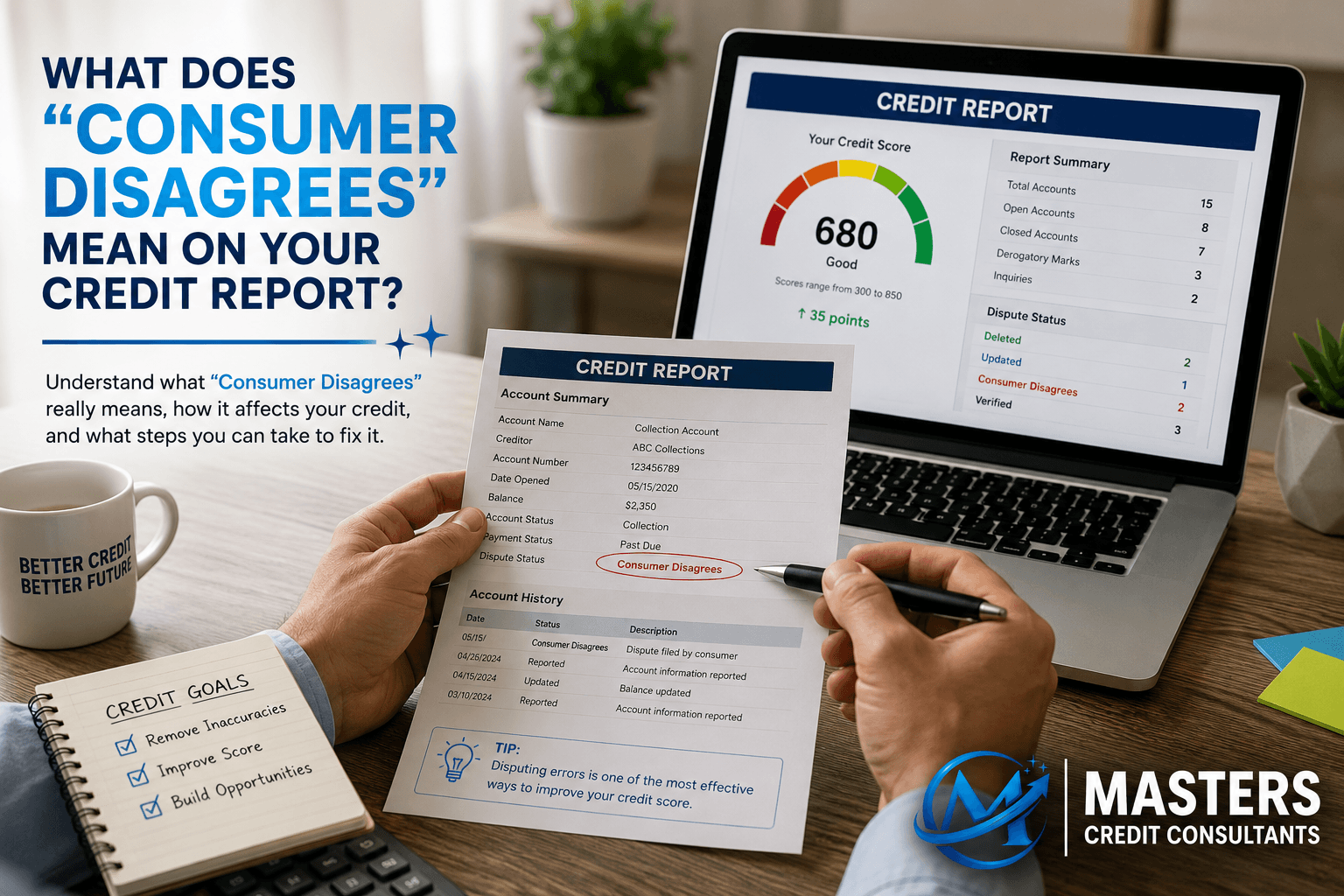

What Does “Consumer Disagrees” Mean on Your Credit Report?
If your credit report shows “Consumer Disagrees,” it means you’ve disputed information on your credit report, but the creditor or credit bureau chose to keep the account as reported. The remark simply indicates that you disagree with the reported information—it does not automatically mean the information is inaccurate or that your dispute was unsuccessful.
Understanding what this remark means can help you decide whether additional action is necessary and how it may affect your financial goals.
In This Article You’ll Learn
- What the “Consumer Disagrees” remark actually means and why it appears.
- Whether it affects your credit score, loan approvals, or business funding opportunities.
- What steps you can take next if you believe the information is still incorrect.

Table of Contents
- What Does “Consumer Disagrees” Mean on Your Credit Report?
- Why Does the “Consumer Disagrees” Remark Appear?
- Does “Consumer Disagrees” Hurt Your Credit Score?
- How the Credit Dispute Process Works
- Common Reasons Consumers File Credit Disputes
- What to Do If You Still Disagree With the Results
- When Professional Credit Repair Services May Help
- People Also Ask
- Final Thoughts
Consumer Disagrees on Your Credit Report: What It Means and What to Do
The phrase “Consumer Disagrees” is a remark added to a credit account after a consumer disputes information reported by a creditor or credit bureau.
In many cases, the lender investigates the dispute and determines that the account information should remain unchanged. Instead of removing or correcting the account, the credit report may include a statement indicating that the consumer disagrees with the reported information.
Think of it as a note that says:
“The consumer disputes the accuracy of this account, but the furnisher has verified the information as reported.”
This remark provides context for future lenders reviewing your credit report, but it doesn’t necessarily indicate that the account is inaccurate.
If you’re unsure whether a disputed item was handled correctly, working with experienced credit repair services from https://www.masterscredit.com/ can help you better understand your options and identify legitimate reporting errors.
Why Does the “Consumer Disagrees” Remark Appear?
There are several reasons why this notation may appear on your credit report.
The most common situations include:
- You disputed an account online.
- You mailed a dispute to a credit bureau.
- A credit repair company submitted a dispute on your behalf.
- The creditor verified the account.
- The bureau completed its investigation but left the account unchanged.
For example:
Suppose you believe a collection account belongs to someone else. You submit documentation supporting your claim.
After investigating, the collection agency confirms that the account belongs to you.
Instead of deleting the account, your report may simply state:
This tells anyone reviewing your report that the account has been disputed.
A “Consumer Disagrees” remark is not automatically negative. It simply documents that a dispute occurred and the account remained after investigation.
Does “Consumer Disagrees” Hurt Your Credit Score?
No.
The remark itself does not directly lower your FICO® or VantageScore® credit score.
Credit scoring models evaluate factors such as:
- Payment history
- Credit utilization
- Account age
- Credit mix
- Recent inquiries
A simple dispute notation is not a scoring factor.
However, the underlying account still affects your score.
For example:
If the disputed account is a collection or charge-off, it may continue affecting your score—not because of the remark itself, but because of the negative account.
How the Credit Dispute Process Works
Understanding the process can help you determine your next steps.
Step 1: Review Your Credit Report
Obtain copies of your reports from all three major credit bureaus and carefully review each account.
Look for:
- Incorrect balances
- Duplicate accounts
- Identity theft
- Incorrect payment history
- Accounts that don’t belong to you
Step 2: Submit a Credit Dispute
You may dispute information with:
- Experian
- Equifax
- TransUnion
- The original creditor
Provide supporting documentation whenever possible.
Examples include:
- Identity theft reports
- Proof of payment
- Court documents
- Account statements
- Driver’s license
- Utility bills
Step 3: Investigation
The credit bureau typically contacts the company reporting the information.
The furnisher reviews:
- Account records
- Payment history
- Ownership
- Documentation
If errors are found, corrections are made.
If the information is verified, the account usually remains.
Step 4: Final Results
After the investigation:
✅ Account corrected
✅ Account deleted
✅ Account updated
OR
Consumer Disagrees remark added.
Common Reasons Consumers File Credit Disputes
Many disputes involve legitimate reporting mistakes.
Some of the most common include:
- Identity theft
- Duplicate collections
- Incorrect late payments
- Wrong balances
- Mixed credit files
- Paid collections still showing unpaid
- Incorrect account ownership
- Accounts older than reporting limits
- Fraudulent inquiries
Not every dispute results in removal.
However, correcting legitimate reporting errors can make a meaningful difference over time.
Entrepreneurs often overlook personal credit until they apply for business funding. Maintaining accurate credit reports today can improve your chances of qualifying for financing, favorable loan terms, and future growth opportunities.
What to Do If You Still Disagree With the Results
Receiving a “Consumer Disagrees” notation doesn’t necessarily mean the process is over.
You still have options.
Consider:
- Requesting another investigation if you have new evidence.
- Contacting the creditor directly.
- Filing additional documentation.
- Reviewing your reports from all three bureaus.
- Consulting a reputable credit professional.
Sometimes a second review accompanied by stronger documentation can lead to a different outcome.
Need Guidance?
If you’re unsure whether the information on your credit report is accurate, scheduling a consultation can help you understand your rights, review your credit profile, and determine the most effective next steps.
You can learn more or request assistance by visiting https://www.masterscredit.com/sign-up/.
When Professional Credit Repair Services May Help
Some situations are straightforward.
Others involve multiple creditors, inconsistent reporting, or documentation that requires careful review.
Professional credit repair services may be beneficial when:
- Multiple accounts contain errors.
- Identity theft is involved.
- Collection agencies report inaccurate information.
- Credit bureaus fail to correct documented mistakes.
- You’re preparing to buy a home or start a business.
A reputable credit fixing service focuses on identifying reporting inaccuracies, educating consumers, and helping them navigate the dispute process—not making unrealistic promises.
Whether you’re searching for Credit Repair Services Near Me, Credit Repair Near Me, Credit Repair Atlanta, Credit repair in Miami, or evaluating different Credit Repair Agencies, choose a company that emphasizes compliance, transparency, and consumer education.
Masters Credit provides educational resources and personalized support designed to help consumers better understand their credit reports while working toward stronger financial health.
Strong personal credit can open doors to business credit, startup financing, equipment loans, commercial leases, and vendor accounts. Reviewing your credit before applying for funding can save time and improve approval odds.
Frequently Asked Questions About Consumer Disagrees
Can a “Consumer Disagrees” remark be removed?
Yes. If the underlying dispute is resolved or the creditor updates the account, the remark may be removed. You can also request another review if you have additional supporting documentation that was not included in the original investigation.
Does “Consumer Disagrees” mean my dispute failed?
Not necessarily. It usually means the creditor verified the information as reported during the investigation. The notation simply indicates that you continue to disagree with the reported information.
Should I dispute my credit report again?
If you have new evidence or documentation that supports your claim, another dispute may be appropriate. Submitting the same dispute without new information is less likely to produce a different result.
Final Thoughts
A “Consumer Disagrees” remark doesn’t automatically damage your credit score, but it does indicate that a disputed account remains on your credit report after an investigation. The key is understanding whether the information is accurate and taking informed action if you believe it is not.
For entrepreneurs, maintaining an accurate credit profile is especially important. A stronger credit history can improve access to business funding, financing, and growth opportunities. Reviewing your credit reports regularly and addressing legitimate reporting errors can support both your personal and business financial goals.
Masters Credit is a trusted credit repair company dedicated to helping individuals and entrepreneurs improve their credit score, repair inaccurate reporting, strengthen their financial position, and prepare for future business opportunities. Whether you’re looking to improve your credit score fast, meet your credit needs, or build a stronger foundation for business success, experienced guidance can make the process more manageable.
Schedule Your Free Credit Consultation with Masters Credit Consultants
If you are trying to improve your credit after a verified dispute in 2026, professional guidance may help you identify reporting errors and create a personalized recovery strategy.
📞 Phone: 1-844-620-8796
🌐 Website: https://www.masterscredit.com
📅 Schedule Your Free Consultation:
https://www.masterscredit.com/sign-up/
Additional Helpful Links
- Ultimate Guide to Credit Repair: A Proven Blueprint to Rebuild Your Credit and Create More Financial Opportunities
- DIY Credit Repair May Be Hurting Your Credit: Why Strategy Matters More Than Templates
- Credit repair in Miami: Secrets to Boost Score Fast (2026 Guide)
- Credit Repair Atlanta: Rejected Again? Here’s Why
Related Questions
-
Can I dispute the same item on my credit report after it has been verified?
-
What does “verified as accurate” mean on a credit dispute?
- How do I remove a verified collection account from my credit report?
- What should I do if the credit bureau verifies incorrect information?
- Will a verified credit dispute hurt my credit score?
- Should I hire a credit repair company if my dispute was verified?










Leave A Comment